Florian Gall
The Good Nurse: A True Story of Medicine, Madness, and MurderFlorian Gall is a reverend whose unexpected death at Somerset Medical Center turns a recovering patient’s case into the central forensic lead in the investigation of Charles Cullen. Gall had arrived critically ill, improved enough for his digoxin to be discontinued, and then suffered a fatal cardiac arrest with an extraordinarily high concentration of the drug in his body. His case gives investigators a confirmed homicide and a likely weapon, but not, at first, proof tying the killing to Cullen.
Identity and Admission
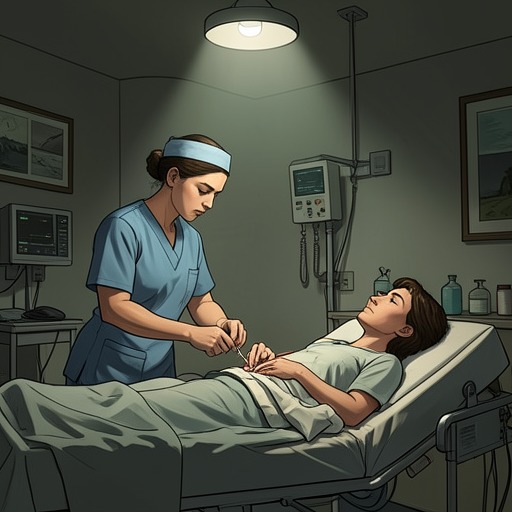
Gall was brought by ambulance to the Somerset Medical Center cardiac care unit nearly nine months after Cullen arrived on the unit. He was gravely ill with an overwhelming bacterial infection, probably pneumonia. His fever was extremely high, his lymph nodes swollen, and his lungs so compromised that he could not deliver adequate oxygen to his heart and brain. A ventilator breathed for him, while dialysis filtered his blood as his kidneys began to fail.
The infection was not the only danger. Gall’s heart was also in trouble: he had atrial fibrillation, in which a heart chamber contracts too rapidly to fill and pump effectively. The cardiologist prescribed digoxin to slow the atrium and restore circulation. At the time, it was a conventional response to an urgent medical problem, not an indication that Gall was being poisoned.
A Recovery Reversed
For Gall’s first week, it was uncertain whether he would survive. His family consented to a do-not-resuscitate order, so that if his body failed, he would not be subjected to extraordinary measures. His condition then began to improve. The order was rescinded, and his digoxin was discontinued. By the second week, his pneumonia was subsiding, his heart rhythm had stabilized, and he was sitting up and eating.
His sister remained close at his bedside. Gall could talk with her and complain about the nurses, tubes, drips, and machines; the familiar irritability of those conversations marked a return to himself. His recovery seemed to point toward leaving the hospital if it continued. That trajectory makes what followed especially stark: on June 28, at about 9:32 in the morning, he unexpectedly went into cardiac arrest. Resuscitation efforts failed, and his death was recorded at 10:10 a.m. Bloodwork showed digoxin levels far beyond the expected range.
The hospital administration recognized that the death was not natural and that Gall was not the first such patient. Internally, he was called Patient 4. At a later meeting, Somerset’s senior vice president listed him among six unexplained critical-care incidents: Joseph Lehman, Frances Kane, Jin Kyung Han, Gall, Francis Agoada, and McKinley Crews. The list placed his death within a cluster rather than leaving it as an isolated medical tragedy.
From Suspicion to a Homicide Finding
Gall’s illness and death raised a question of how the drug could have reached a patient whose treatment with digoxin had already ended. The investigation also examined Cullen’s connection to his care. Cullen was not Gall’s nurse on the night he died, but he had worked with him before and knew his medical history. He had been assigned to Gall for three nights, June 15 through 17. Those facts made Cullen relevant to the inquiry without establishing that he had caused the fatal overdose.
Investigators needed a definite homicide victim, not merely a pattern of unsettling cases. Medical examiner Nobby C. Mambo and Dr. Jackson of the State Toxicology Lab reviewed the records from Somerset’s six unexplained incidents. Gall appeared to them to be the strongest case because his extreme digoxin levels might provide a decisive forensic link. But paperwork alone could not establish who had administered the drug.
The toxicology report, received at 10:38 on a Saturday morning, ruled out roughly ninety-six drugs, from acetaminophen to zolpidem. It found substantial digoxin in several tissues: 23.4 micrograms per liter in the vitreous fluid, 32.0 micrograms per kilogram in the spleen, 40.8 in the heart, and 104 in the kidney. With those results, Mambo amended the report: the cause of death was digoxin toxicity, and the manner of death was homicide. Gall was now a confirmed murder victim, and digoxin the identified weapon. The forensic finding resolved how he died, but did not identify the killer.
Family, Investigation, and Evidentiary Limits
Gall’s sister Lucille understood the significance of the test results without needing them translated into medical language. She was a registered nurse who had worked with digoxin for decades. When Danny Baldwin began to explain the elevated levels in her brother’s blood, she stopped him and recognized what the findings meant: Gall had been killed. Her response gives the laboratory result a personal consequence without displacing its evidentiary importance.
For investigators, Gall became one of two Somerset cases with which they hoped to build a charge against Cullen: Gall’s death as a possible murder, and Jin Kyung Han’s poisoning as a possible attempted murder. They had a victim, a suspected weapon, and a suspect, but had not connected the three. Cullen could characterize suspicious medication orders or cancellations as mistakes, and the available records did not amount to direct proof of an administration. Once he was no longer working at the hospital, investigators also could not simply wait to catch him in the act without risking another patient’s life.
That gap shaped the next stage of the case. The investigators concluded that they needed Cullen to disclose at least one crime to someone he trusted. During the later questioning, they asked about Gall. Cullen began by discussing the reverend, then continued into a much longer account of his own past. The narrative describes that account as a story about himself, not simply as a confession to Gall’s murder; it does not make Gall’s toxicology findings equivalent to a proved admission.
Narrative Significance
Gall’s importance lies in the separation between medical certainty and criminal attribution. His course can be reconstructed in precise clinical and forensic terms: critical illness, improvement, discontinued digoxin, sudden arrest, and toxic concentrations in multiple tissues. The same precision that establishes homicide still leaves unanswered who put the drug into his system. His death therefore changes the investigation decisively while exposing its central weakness: a clear cause and manner of death are not, by themselves, proof against a particular suspect.
His recovery also makes the reversal legible. Gall had moved from ventilator and dialysis toward sitting up, eating, and talking with his sister; his sudden death cuts across that apparent return to health. In the book’s account, he is not simply one more name in a cluster of unexplained events. He becomes the case investigators select as their best forensic lead, the patient whose death can be declared homicide, and the unresolved question that prompts them to seek a trusted listener who might make the connection the laboratory cannot.